
PLC -Definition, application, advantages, disadvantages
In modern industries, PLC plays a major role in controlling the machinery without human intervention, with on-time and without errors, it will give a great revolution to the manufacturing, assembling, and packing to control and monitor the process continuously
What is PLC?
A PLC is a Programmable Logic Controller, it is a rugged industrial computer used to automate processes in the industries, it will control and monitor the state of the machinery continuously.
PLC are designed to withstand heavy industrial environments like dust, heat, vibration, moisture and electrical noise.
it continously monitor thesignal from the input service and controls the output for the logic programmed in it
Defination
PLC is a device which continiously monitor the signal from the input device like sensors, switches, push buttons, and controls the output devices, like valves, motors, and relays according to the logic
Simple PLC workflow
INPUT ——-> PROGRAM LOGIC ———-> OUTPUT
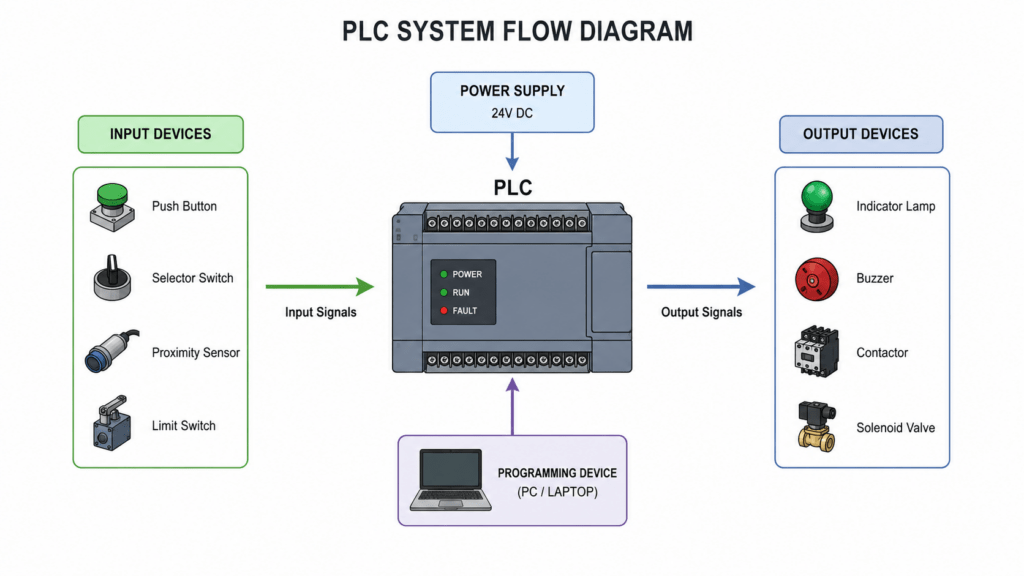
In the flow, the input is the signal from the devices like switch push buttons and sensors,
and the program logic is the code written in the PLC with different types of programming languages, like ladder logic, functional block diagram, instruction list, etc
in the output, the device can be controlled by the PLC according to the Logic and the input signal. It controls devices like motor valve, relay, etc
Application of PLC
PLCs are widely used in industrial automation to control machines, processes, and production systems. Their reliability, flexibility, and ability to operate in harsh environments make them essential in many industries.
The PLC is widely used in most of the inddustriesfor the automate the process, controlling the machines.
- used in the manufacturing industries
- used in the robotic arm for controlling
- used in a conveyor system
- used in the production line
Advantage of plc
- High Reliability
- Easy Programming
- Reduced Wiring
- Fast Operation
- Easy Troubleshooting
- Flexible Modifications
- Compact Design
- Expandability
- Improved Productivity
- Low Maintenance
- Better Monitoring and Control
- Cost-Effective for Large Systems
Disadvantage
- High Initial Cost
- Requires Programming Knowledge
- Cybersecurity Risks
- Dependence on Power Supply
- Limited Processing Capacity
- Hardware Failure Can Stop the Entire Process
- Regular Software Updates May Be Required
- Vendor Dependency
- Communication Issues in Networked Systems
- Troubleshooting Requires Technical Skills
- Environmental Limitations in Extreme Conditions
- Training Requirements for Operators and Maintenance Personnel